
What You See Is What You Get
“What’s your favorite color?”
“Ummmmm…. purple.”
“What’s your least favorite color?”
“Brown. Like ugly brown.”
I’ve been asking this question a lot recently in my individual mindset sessions with athletes. The human brain is pretty simple. What we focus on is what our brain will see. I hold space to make this point in my sessions by playing a little game.

“For 10 seconds, I want you to look around the room and find everything that’s ugly brown.”
They look around, head turning, eyes darting, trying to find all the ugly brown in a very short time. When time is up, I ask them to point out the ugly to me. And here’s the part I don’t like. I ask..
“In those 10 seconds you were scanning the room for ugly brown…what did you find that was purple?”
One by one, my clients answer this question the same way… “I didn’t find any purple.”
I ask, “Why not?”
They answer, “Because I was looking for ugly brown.”
Bingo.
What we want to see is what we get.
Imagine tryouts. There’s a lot of ugly brown in tryouts. The competition. The conditioning. The thoughts in our head telling us we aren’t good enough, we don’t belong. There’s a lot of brown at tryouts.
There’s some good in tryouts too. Hints of purple in the friends you start to make, the progress in the fitness, maybe a good play here and there. Simply showing up and giving your all is a heck of a purple right there. But that purple, those favorite color moments, well, if we aren’t looking for them, we simply won’t see them. It doesn’t mean they aren’t there. They are. But we won’t see them because we haven’t asked our brain to find them.
Let’s try an experiment together to show how interestingly our brain works. OK, here’s the experiment…
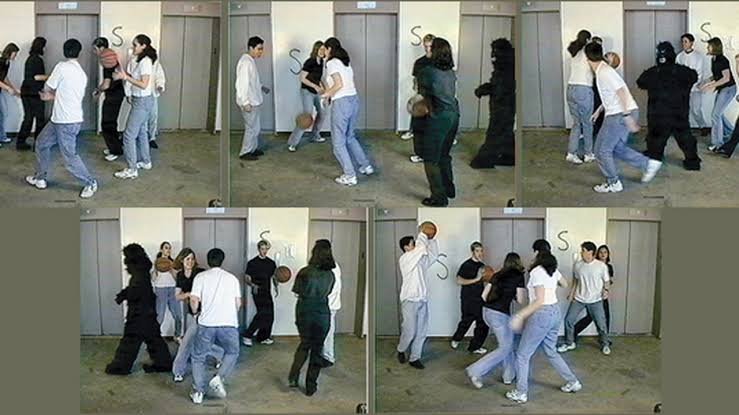
Take a look at this video. It’s showing kids passing a basketball around a basketball court. The goal is to count how many times the players wearing white pass the basketball. Ready? Go…
https://www.youtube.com/watch?v=vJG698U2Mvo
How many passes did you count?
Did you see the gorilla?
The "Invisible Gorilla" experiment is a psychological study done in 1999 by Daniel Simons and Christopher Chabris at Harvard University. The task is simple. Count how many passes the players in white make. The trick? To see if people notice the person in a gorilla suit walking into the middle of the group, thumping their chest, and walking off. Remarkably, about half of the people fail to see the gorilla because they are focused on the task of counting.
What we see is what we get.
It’s called…
Selective Attention: the cognitive process of focusing on a specific stimulus in your environment while ignoring other distractions.
It’s the way our brains work. The brain is like a filter. I believe podcaster Mel Robbins once described this as the brain having a hair net around it that serves as a filter. With millions of stimuli available, the hair net will only let in what really matters to us at the moment. How kind. But also I wonder…

Is what matters to us in the moment really what’s best for us?
Take practice, for example. When driving to practice, we have two choices. We can think practice is going to stink that day. We pull up to the field, and from the very first few minutes, we start looking for all the bad in practice that proves our point. And we feel oddly good about the fact that we were right; practice did stink. And we might then be even more convinced that if practice was that bad, games are going to be so much worse…and then? They are. Because that’s what we had programmed our brains to find.
It’s called Confirmation Bias: the tendency to search for, interpret, favor, and recall information that supports your existing beliefs while ignoring or discounting contrary evidence.
This is our brain working “well for us,” but what if we worked well for our brain?
What if we decided to choose to think about how good practice was going to be that day? We pull up to the field, and from the very first minute we arrive, we start looking for the purple. That’s also confirmation bias, but with the choice of looking for the good. I think that’s the prep work needed to set ourselves up for success on (and off) the field.
We have a choice in how we view our situation, teammates, coaches, opponents, refs, ourselves…It can be that simple.
If we choose to find the purple, this doesn’t mean that things will go perfectly. We will make mistakes. But when we are looking for purple, those mistakes are easier to bounce back from.
I was working with a client the other day who was struggling with mistakes. We met for our first session to lay the groundwork for my mindset system. I taught him about mindfulness, the zones in our brain, and asked him to get to know his warnings. He played in a scrimmage the very next day. Typically, when he makes mistakes, it’s hard for him to bounce back. And in this scrimmage, he was really challenged with two mistakes back to back. But on his third attempt, he tried something different.
He gave himself a chance. A chance to try and see what he could do. And in doing so, his third attempt was successful. What he grew that day was confidence. Confidence that even when there are mistakes, even when there’s ugly brown surrounding him, he will choose to look for the purple.
Some days will be easier than others. I know this because I choose to live this every day of my life. My advice? Give yourself grace. That’s the gift mindfulness gives to those who choose to use it. Space to fail, learn, grow, repeat when we are ready.
What’s your favorite color? What’s the ugliest color you’ve ever seen? What are you going to choose to look for today?
What you see is what you get, so choose wisely!
